

Why Retirement Planning Is Critical for Leadership Continuity
March 13, 2026
Why Junior Mining Companies Need a Different Benefits Strategy Than Senior Producers
April 10, 2026
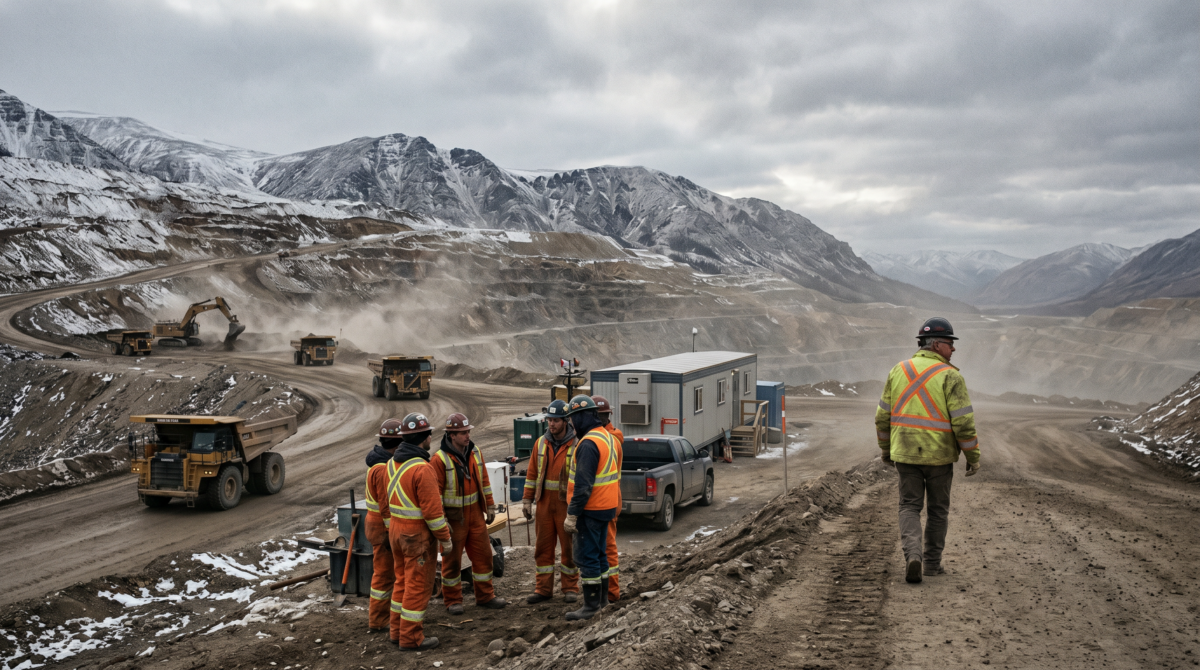
Benefits become more important when the cost of losing the wrong person goes up.
Canada’s mining labour challenge is usually framed as a hiring problem. It is that, but that is not the full story.
The bigger risk is what happens when experienced people leave faster than they can be replaced.
Across Canada, mining employers are already operating in a tight labour market. MiHR’s 2024 outlook found five of six labour-tightness indicators still signaling concern, and projected a baseline hiring gap of 39,269 workers between 2024 and 2034. Recent reporting has also pointed to an aging workforce, with only 5% of Canada’s mining workforce under 25.
That matters because in mining, experience is not evenly distributed. It tends to sit with a small number of operators, technical specialists, supervisors, and executives who carry more institutional knowledge than the org chart suggests.
When one of them leaves, the impact is rarely isolated.
The real issue is continuity
In many mining organizations, especially junior and mid-stage companies, teams are lean by design.
A small group is often responsible for capital planning, technical oversight, contractor coordination, compliance, community relationships, and execution. When that group is stable, a company can keep momentum. When it is not, the disruption spreads quickly.
This is where the labour issue becomes more serious than headcount.
The question is not simply whether you can hire. The question is whether you can preserve continuity as projects become more complex and the margin for delay shrinks.
Pelorus has already positioned this well in its existing mining content: workforce instability does not stay inside HR. It affects schedule certainty, cost pressure, insurance conversations, and management credibility.
Experience loss shows up long before a role is officially vacant
Not every workforce risk starts with a resignation.
Sometimes it shows up as fatigue. Sometimes it looks like slower decision-making, stretched supervisors, inconsistent contractor oversight, or a leadership team carrying too much operational weight for too long.
In mining, those pressures matter because work is remote, safety-sensitive, and dependent on coordination across multiple moving parts. A company can still look staffed on paper while becoming thinner in practice.
That is one reason this issue deserves more attention. The hidden cost is not only turnover. It is the erosion of judgment, responsiveness, and operating resilience before turnover formally happens.
Why this is especially important for junior and growth-stage mining companies
Large, established producers can often absorb leadership transitions and operational gaps more easily. Early-stage and growth-stage mining companies usually cannot.
They are still building systems, still relying on a concentrated group of decision-makers, and still trying to prove they can move from one stage of development to the next. In that environment, people-risk can become execution-risk quickly.
MiHR’s outlook supports that broader concern. Its 2024 analysis shows hiring pressure not only across production and trades, but also among supervisors, coordinators, superintendents, technical roles, and other occupations that support continuity and execution.
That matters because these are not interchangeable roles. They are the roles that carry memory, judgment, and operational discipline.
Benefits become more important when the cost of losing the wrong person goes up
In mining, benefits are often discussed as part of total compensation. That is incomplete.
At a certain point, benefits become part of workforce protection.
That includes:
- support that helps keep experienced people sustainable in demanding environments
- access to care that works in remote and rotational settings
- mental health support that is usable, not theoretical
- executive and key-person planning that protects leadership continuity
- retirement and retention strategies that reduce the risk of avoidable departures
This is now a Canadian industry issue, not a company-specific one
The broader environment is reinforcing the same message.
In October 2025, Canadian Mining Journal reported that labour gaps could slow the sector’s growth. In March 2026, the federal government launched a Mining and Minerals Workforce Alliance to address skilled-worker shortages in mining and critical minerals. These are signals that the workforce problem is not temporary and not isolated.
For employers, that means retention cannot be treated as a secondary issue.
If the market is structurally tight, replacing experienced people will stay expensive, slow, and uncertain. Protecting continuity becomes the better strategy.
The bottom line
Mining companies do not just face a talent gap; they face an experience gap. And in a business where execution depends on a relatively small number of capable people, the loss of experience can create far more risk than a vacancy ever suggests.
Pelorus helps mining organizations design benefits and workforce strategies that do more than fill a requirement. They help protect continuity, support leadership, and reduce the hidden cost of getting retention wrong.